

Github · GitHub Repository Radar
microsoft monaco-editor
A browser based code editor
Stars
46,654
Forks
4,118
Watchers: 46,654
Language
License: MIT License
Repository Radar Score
64 / 100
Growth
- 7d
- +0
- 30d
- +0
- %
- 0.0%
Not enough metric snapshots yet to chart growth for this repository.
Score breakdown
- popularity 85
- growth 0
- activity 100
- freshness 100
- community 85
Need help integrating this stack?
Our team builds with modern open-source stacks. Tell us what you are shipping.
Get a quote →The Monaco Editor is the fully featured code editor from VS Code. Check out the VS Code docs to see some of the supported features.
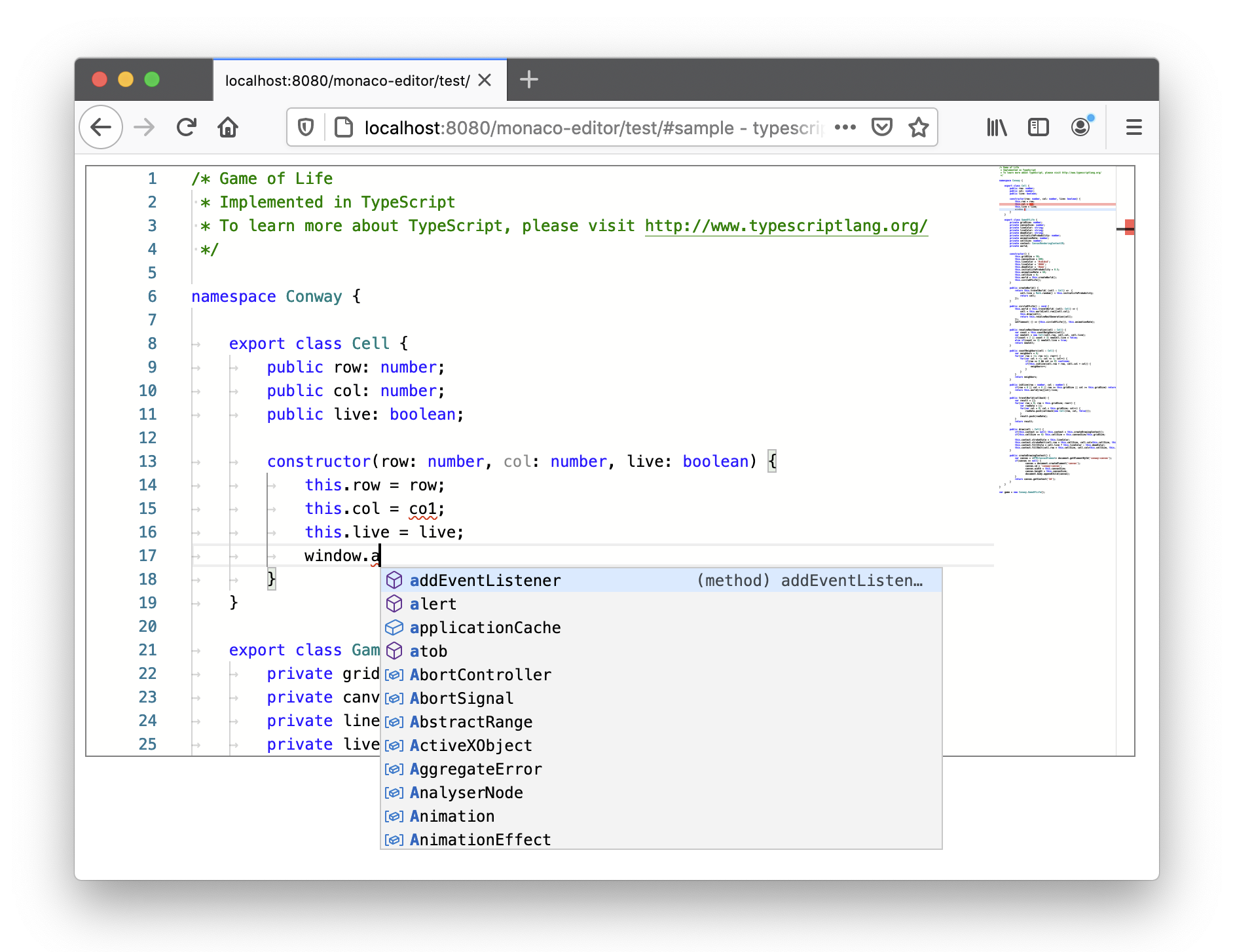
Try out the editor and see various examples in our interactive playground.
The playground is the best way to learn about how to use the editor, which features is supports, to try out different versions and to create minimal reproducible examples for bug reports.
> npm install monaco-editor
You will get:
- inside
/esm: ESM version of the editor (compatible with e.g. webpack) monaco.d.ts: this specifies the API of the editor (this is what is actually versioned, everything else is considered private and might break with any release).
⚠️ The monaco editor also ships an AMD build for backwards-compatibility reasons, but the AMD support is deprecated and will be removed in future versions.
To load the editor in a specific language, make sure that the corresponding nls script file is loaded before the main monaco editor script. For example, to load the editor in German, include the following script tag:
<script src="path/to/monaco-editor/esm/nls.messages.de.js"></script>Check the sources for available languages.
Monaco editor is best known for being the text editor that powers VS Code. However, it's a bit more nuanced. Some basic understanding about the underlying concepts is needed to use Monaco editor effectively.
Models are at the heart of Monaco editor. It's what you interact with when managing content. A model represents a file that has been opened. This could represent a file that exists on a file system, but it doesn't have to. For example, the model holds the text content, determines the language of the content, and tracks the edit history of the content.
Each model is identified by a URI. This is why it's not possible for two models to have the same URI. Ideally when you represent content in Monaco editor, you should think of a virtual file system that matches the files your users are editing. For example, you could use file:/// as a base path. If a model is created without a URI, its URI will be inmemory://model/1. The number increases as more models are created.
An editor is a user facing view of the model. This is what gets attached to the DOM and what your users see visually. Typical editor operations are displaying a model, managing the view state, or executing actions or commands.
Providers provide smart editor features. For example, this includes completion and hover information. It is not the same as, but often maps to language server protocol features.
Providers work on models. Some smart features depends on the file URI. For example, for TypeScript to resolve imports, or for JSON IntelliSense to determine which JSON schema to apply to which model. So it's important to choose proper model URIs.
Many Monaco related objects often implement the .dispose() method. This method is intended to perform cleanups when a resource is no longer needed. For example, calling model.dispose() will unregister it, freeing up the URI for a new model. Editors should be disposed to free up resources and remove their model listeners.
- Learn how to integrate the editor with these complete samples.
- Learn how to use the editor API and try out your own customizations in the playground.
- Explore the API docs or read them straight from
monaco.d.ts. - Read this guide to ensure the editor is accessible to all your users!
- Create a Monarch tokenizer for a new programming language in the Monarch playground.
- Ask questions on StackOverflow! Search open and closed issues, there are a lot of tips in there!
Create issues in this repository for anything related to the Monaco Editor. Please search for existing issues to avoid duplicates.
❓ What is the relationship between VS Code and the Monaco Editor?
The Monaco Editor is generated straight from VS Code's sources with some shims around services the code needs to make it run in a web browser outside of its home.
❓ What is the relationship between VS Code's version and the Monaco Editor's version?
None. The Monaco Editor is a library and it reflects directly the source code.
❓ I've written an extension for VS Code, will it work on the Monaco Editor in a browser?
No.
Note: If the extension is fully based on the LSP and if the language server is authored in JavaScript, then it would be possible.
❓ Why all these web workers and why should I care?
Language services create web workers to compute heavy stuff outside of the UI thread. They cost hardly anything in terms of resource overhead and you shouldn't worry too much about them, as long as you get them to work (see above the cross-domain case).
❓ I see the warning "Could not create web worker". What should I do?
HTML5 does not allow pages loaded on file:// to create web workers. Please load the editor with a web server on http:// or https:// schemes.
❓ Is the editor supported in mobile browsers or mobile web app frameworks?
No.
❓ Why doesn't the editor support TextMate grammars?
- Please see https://github.com/bolinfest/monaco-tm which puts together
monaco-editor,vscode-onigurumaandvscode-textmateto get TM grammar support in the editor.
We are welcoming contributions from the community! Please see CONTRIBUTING for details how you can contribute effectively, how you can run the editor from sources and how you can debug and fix issues.
This project has adopted the Microsoft Open Source Code of Conduct. For more information see the Code of Conduct FAQ or contact opencode@microsoft.com with any additional questions or comments.
Licensed under the MIT License.




Repository Radar analysis
Deterministic insights derived from public metadata and our observations — not personal testing or reviews.
Why this repository is interesting
- High absolute popularity (46,654 stars) signals broad adoption.
- Maintained recently (last push 2 weeks ago).
Who should use it
- Developers working primarily with JavaScript
Potential use cases
- Reference or evaluate JavaScript open-source approaches in this domain
Strengths
- Recent repository activity
- README present in our index
- Declared license: MIT License
- Substantial fork count (4,118) suggests reuse and contribution interest
Limitations / considerations
- Insights are derived from public metadata and our observations — not a substitute for code review
What to watch
- Re-check last push, issues, and releases on GitHub before production adoption
Strong signals: Strong community interest · Active maintenance
Source: GitHub (public metadata) + Repository Radar analysis. We do not claim ownership of third-party repositories.
Similar repositories
vercel/next.js
★ 142,069 · JavaScript · radar 66
prettier/prettier
★ 52,233 · JavaScript · radar 65
Asabeneh/30-Days-Of-JavaScript
★ 46,761 · JavaScript · radar 61
QVerisAI/qveris-agent-toolkit
★ 260 · JavaScript · radar 52
atom/atom
★ 60,752 · JavaScript · radar 49
ckelsoe/prompt-architect
★ 292 · JavaScript · radar 38