-38%
Lower Admin Cycle Time

Case study
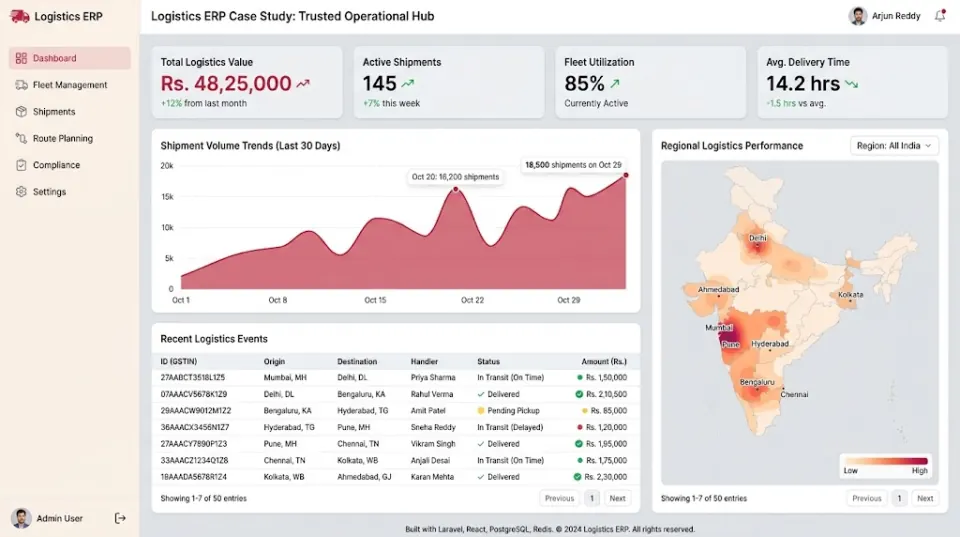
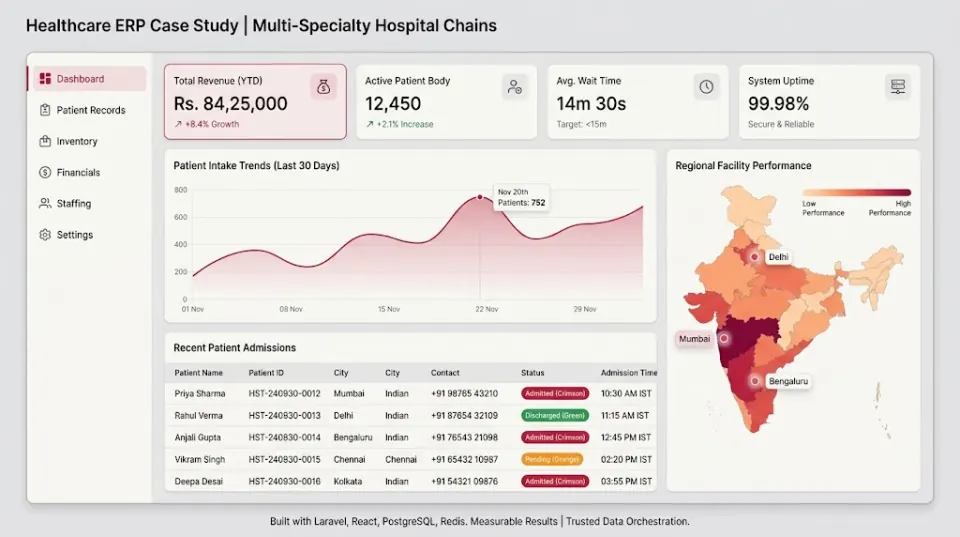
The platform was built as a phased healthcare operations solution with role-based consoles, integrations, automation, reporting, and AI-assisted triage workflows.

Results
-38%
Lower Admin Cycle Time
-27%
Fewer Support Tickets
16 weeks
First Production Release
Challenge
Fragmented EMR-adjacent workflows and no trustworthy ops KPIs across wards.
Solution
Phased hospital ops platform with role-based consoles, integrations, and AI triage assists.
Shriram IT Ventures designed and developed a hospital management system to help healthcare organizations centralize hospital operations, streamline administrative workflows, connect operational data, and improve visibility across departments.
The platform was built as a phased healthcare operations solution with role-based consoles, integrations, automation, reporting, and AI-assisted triage workflows.
Project: Hospital Management System
Industry: Healthcare
Project Type: Healthcare Software / Hospital Management System
Client: Northbridge Health
Development Timeline: 16 Weeks
Engagement: Product Engineering & Full-Stack Development
A hospital management system (HMS) is software that helps hospitals manage operational, administrative, clinical-support, and reporting workflows through a centralized digital platform.
A modern hospital management system can connect departments, users, workflows, and operational information while giving administrators better visibility into day-to-day hospital activities.
The goal is to replace fragmented processes with a structured digital workflow:
Capture → Manage → Coordinate → Automate → Monitor → Report
Hospitals operate through interconnected departments, teams, workflows, and information systems.
When operational data is distributed across multiple tools, teams may spend significant time:
Reconciling information
Managing manual workflows
Coordinating between departments
Preparing operational reports
Tracking activities
Resolving support issues
Monitoring operational performance
The challenge for Northbridge Health was to create a more centralized approach to hospital operations while providing leadership with clearer and more reliable operational visibility.
Fragmented hospital workflows
Manual operational processes
Limited visibility across departments
Tools that were difficult to integrate
Lack of trustworthy operational KPIs
Time-consuming data reconciliation
Shriram IT Ventures developed the hospital management system in phases, starting with core operational workflows and then introducing automation and AI-assisted capabilities.
The platform combines:
Role-based interfaces
Hospital operations workflows
Backend APIs
Data management
Integrations
Reporting
Automation
AI-assisted triage
Operational monitoring
This approach allowed the system to evolve from core workflows into a broader healthcare operations platform.
Different hospital stakeholders require different information and permissions.
The platform uses role-based access and dedicated interfaces to provide users with the workflows relevant to their responsibilities.
This helps ensure that:
Users see relevant information
Access can be controlled
Department workflows remain organized
Administrative functions are separated from other operations
Sensitive healthcare information can be handled according to defined permissions
The platform brings operational workflows into a centralized system rather than relying on disconnected tools.
This helps healthcare organizations establish a common operational layer for managing hospital activities.
Centralization can improve:
Workflow visibility
Data consistency
Accountability
Reporting
Operational coordination
Hospital software rarely operates in isolation.
The platform architecture was designed with integrations in mind so that different systems and operational data sources can communicate with the core application.
This reduces the need for staff to repeatedly transfer information between disconnected systems.
The platform includes AI triage assistance as part of its healthcare workflow capabilities.
AI-assisted workflows can help organize and prioritize information so healthcare operations teams can make faster, more informed decisions.
AI is positioned as an assistance layer rather than a replacement for qualified healthcare professionals.
Healthcare leadership needs reliable operational information to understand how the organization is performing.
The platform provides a foundation for monitoring operational KPIs and generating structured reports.
Reporting capabilities can help organizations understand:
Operational activity
Workflow performance
Department-level information
Process bottlenecks
Support activity
Operational trends
Manual hospital administration can consume significant staff time.
The system was designed to introduce automation into repetitive operational processes.
Automation can help reduce:
Manual data handling
Repetitive administrative work
Information reconciliation
Operational delays
Duplicate data entry
The platform follows a structured operational workflow.
Hospital activities and operational information enter the platform.
Information is structured according to users, departments, workflows, and operational requirements.
Business rules, integrations, and workflow logic process the information.
Automation and AI-assisted capabilities help users manage relevant tasks.
Operational information is made available through dashboards and monitoring workflows.
Leadership can use structured reporting and KPIs to understand operational performance.
The platform was engineered as a modern healthcare application with a modular architecture.
A React/Next.js-based administrative interface provides role-based screens and operational workflows.
Laravel and Node.js APIs handle application logic, authentication, authorization, integrations, and data workflows.
PostgreSQL provides structured data storage for the application.
Queue workers handle asynchronous jobs and background processing.
AI-assisted capabilities support selected healthcare workflow and triage use cases.
Application monitoring and observability help the engineering team track system behavior and operational health.
Healthcare organizations generate large amounts of operational information.
AI can help make this information easier to process and act upon when used within clearly defined workflows.
AI-assisted healthcare software can support areas such as:
Information classification
Triage assistance
Workflow prioritization
Summarization
Operational recommendations
Administrative automation
However, AI should be implemented with appropriate safeguards, permissions, auditability, and human oversight—particularly when software interacts with healthcare workflows.
A modern HMS can support multiple stakeholders across a healthcare organization.
Get better visibility into operational workflows, performance, and reporting.
Manage day-to-day workflows through centralized tools.
Monitor activities and operational KPIs relevant to their departments.
Manage integrations, application infrastructure, permissions, and system reliability.
Use centralized reporting to understand operational performance and identify areas requiring attention.
Healthcare applications require stronger attention to security and privacy than many conventional business applications.
A hospital management platform should consider:
Role-based access control
Authentication
Authorization
Audit trails
Data encryption
Secure APIs
Least-privilege access
Secure data storage
Backup and recovery
Monitoring and logging
Regulatory requirements applicable to the deployment region
Security and compliance requirements should be determined based on the specific country, healthcare environment, data types, integrations, and deployment model.
Shriram IT Ventures used a phased product engineering approach.
We identified core operational workflows, system requirements, user roles, integrations, and technical constraints.
The initial release focused on essential hospital workflows and role-based interfaces.
Additional integrations and workflow automation were introduced to reduce manual operational processes.
AI-assisted functionality was incorporated into selected workflows, including triage assistance.
The platform was prepared for production with infrastructure, queues, observability, and operational monitoring.
The hospital management platform was delivered over 16 weeks from discovery kickoff to the first production release.
Discovery → Architecture → Core workflows → Integrations → Automation → AI assistance → Production
The phased approach allowed the team to prioritize critical workflows first and introduce more advanced capabilities progressively.
The platform was not built simply as a collection of hospital forms.
The engineering approach focused on creating an operational system that connects:
People + Workflows + Data + Integrations + Automation + Intelligence
This allows the platform to evolve as healthcare operations become more complex.
The architecture can support future expansion into additional hospital departments, integrations, reporting capabilities, automation, and AI-assisted workflows.
Shriram IT Ventures can build custom healthcare software for organizations that need more than an off-the-shelf hospital application.
Our healthcare software development capabilities include:
Custom hospital operations and management platforms.
Integrated enterprise systems for healthcare organizations.
Digital workflows that reduce repetitive administrative processes.
Operational dashboards and KPI reporting for healthcare leadership.
API-based integration between healthcare applications and external systems.
AI-assisted workflows for healthcare administration, information processing, triage assistance, and operational automation.
Mobile applications for healthcare organizations, staff, patients, and operational teams.
Custom hospital management software can be relevant to:
Hospitals
Multi-specialty hospitals
Hospital groups
Clinics
Healthcare networks
Diagnostic centers
Specialty healthcare providers
Healthcare startups
Healthcare technology companies
The exact modules and workflows should be designed around the organization's operational model rather than using a one-size-fits-all approach.
Healthcare organizations need software that fits their actual workflows—not another generic dashboard.
Shriram IT Ventures combines healthcare software development, full-stack engineering, cloud infrastructure, automation, AI, and security-focused architecture to build custom healthcare platforms.
Whether you need a hospital management system, healthcare ERP, hospital operations platform, healthcare dashboard, or AI-powered healthcare application, our team can help take the product from architecture to production.
Product discovery → UX → Architecture → Development → Integrations → AI → Security → Deployment
More work
Keep exploring
Related next steps, proof, and silo neighbors — kept short on purpose.
Next step
Best next click from this page.
Trust
Profiles buyers already check — we link only to directories we publish on this site.
Studio
Ajnara Homes, Greater Noida, Uttar Pradesh, 201304, India
Share your roadmap. We’ll come back with scope options, timeline ranges, and who from Shriram IT Ventures should be in the room.