

What Is JEV? The AI Reasoning Primitive for Verification, Reranking and Intellig
Artificial intelligence systems are becoming increasingly capable of generating answers, writing software, searching information, operating tools and completing multi-step tasks.
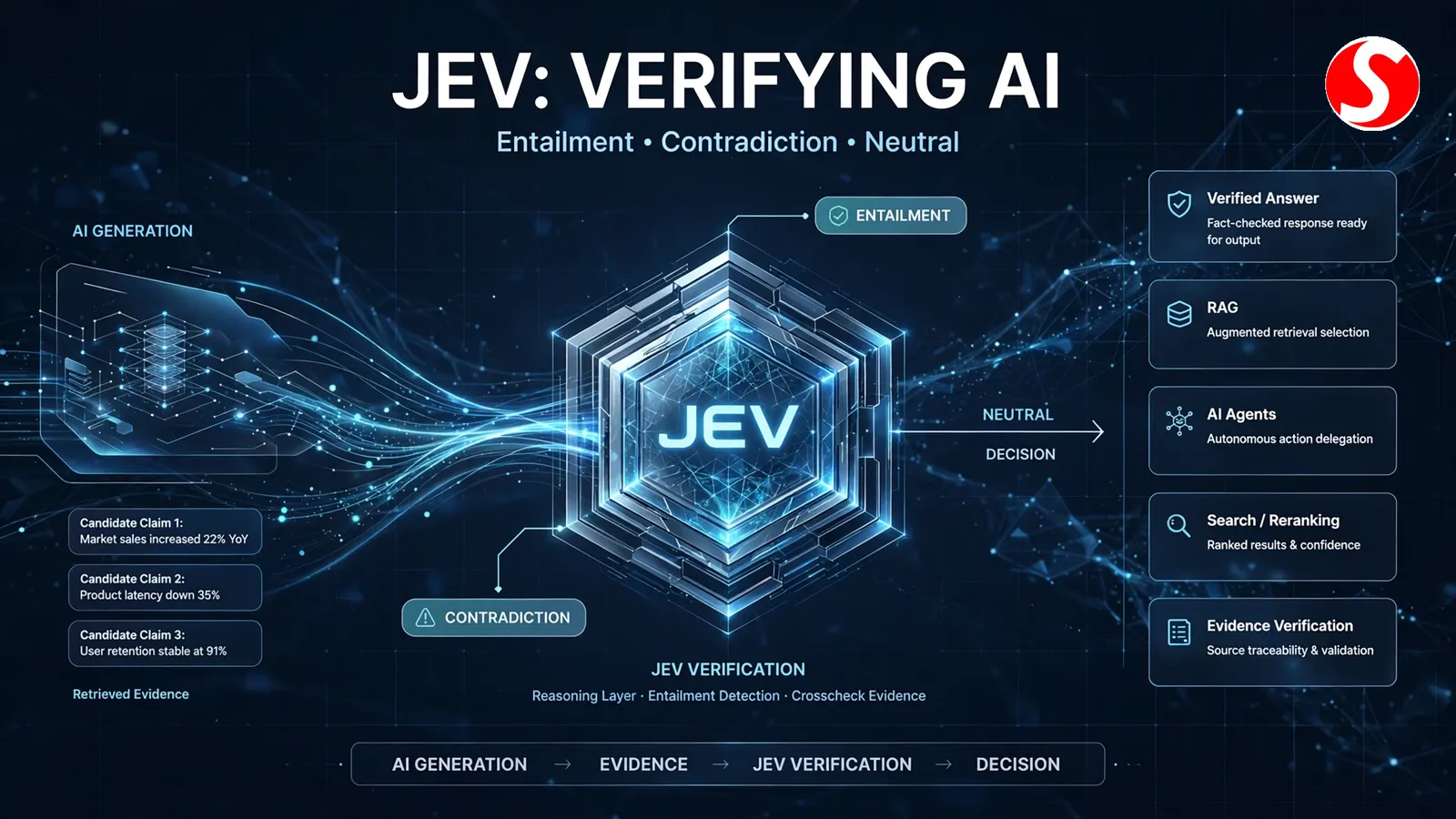
What Is JEV? The AI Reasoning Primitive for Verification, Reranking and Intelligent Agents
Artificial intelligence systems are becoming increasingly capable of generating answers, writing software, searching information, operating tools and completing multi-step tasks.
But generating an answer is only one part of building a reliable AI system.
The more difficult question is:
How does an AI system determine whether an answer, claim, action or decision is actually supported by the information available to it?
This is where JEV becomes interesting.
JEV is an AI reasoning primitive built around a simple but powerful idea: instead of asking an AI model to generate another answer, give it a premise and a hypothesis and ask it to determine the relationship between them.
The result is one of three fundamental relationships:
Entailment — the premise supports the hypothesis.
Contradiction — the premise conflicts with the hypothesis.
Neutral — the premise does not establish the hypothesis.
The open-source OpenJev implementation applies this concept through a cross-encoder architecture and exposes capabilities such as prediction, reranking, grading and latent representations.
This makes JEV particularly interesting for modern AI systems involving RAG, AI agents, search, answer verification, content moderation, ranking and automated decision-making.
What Is JEV?
JEV can be understood as a general-purpose judgment and verification primitive for AI systems.
Instead of primarily asking:
"What is the answer?"
JEV asks:
"Does this statement follow from the information I have?"
That difference is important.
A traditional generative AI workflow might look like:
   User Question
        ↓
      AI Model
        ↓
   Generated Answer
A JEV-assisted workflow can look like:
User Question
       ↓
Retrieval / Reasoning
       ↓
Candidate Answers
       ↓
JEV Evaluation
       ↓
Entailment / Contradiction / Neutral
       ↓
Selected or Verified Answer
This creates a separation between generation and verification.
The generator creates possibilities.
The JEV layer evaluates those possibilities.
The Three JEV Outcomes
1. Entailment
The premise provides sufficient support for the hypothesis.
Premise:
"Delhi is the capital of India."

Hypothesis:
"India's capital is Delhi."

Result:
ENTAILMENT
This can be useful when verifying generated answers against retrieved documents.
2. Contradiction
The premise conflicts with the hypothesis.
Premise:
"The product costs ₹50,000."

Hypothesis:
"The product costs ₹20,000."

Result:
CONTRADICTION
This can help identify potentially incorrect generated information.
3. Neutral
The premise neither proves nor disproves the hypothesis.
Premise:
"The company develops Laravel applications."

Hypothesis:
"The company has 50 employees."

Result:
NEUTRAL
Neutrality is particularly important because an AI system should not automatically convert missing information into a positive claim.
Why JEV Matters for Generative AI
Large language models are excellent at generating information.
However, generation and verification are different problems.
Consider a typical RAG system:
User
 ↓
Retriever
 ↓
Documents
 ↓
LLM
 ↓
Answer
The LLM receives retrieved information and generates an answer.
But another question remains:
Did the final answer actually follow from those documents?
A verification layer can change the architecture:
                     ┌───────────────┐
                     │   User Query  │
                     └───────┬───────┘
                             ↓
                     ┌───────────────┐
                     │   Retriever   │
                     └───────┬───────┘
                             ↓
                     ┌───────────────┐
                     │   LLM / RAG   │
                     └───────┬───────┘
                             ↓
                     ┌───────────────┐
                     │  JEV Layer    │
                     └───────┬───────┘
                             ↓
                ┌────────────┼────────────┐
                ↓            ↓            ↓
           Entailment   Contradiction   Neutral
                ↓            ↓            ↓
             Accept       Reject       Review
This is one of the most interesting applications of JEV.
JEV as an AI Reranker
Search systems frequently generate multiple possible results.
For example:
Question:
Which gas do plants absorb during photosynthesis?

Candidate 1:
Oxygen

Candidate 2:
Carbon dioxide

Candidate 3:
Nitrogen
A JEV system can evaluate the candidates against the question and use the entailment relationship to identify the strongest candidate.
OpenJev exposes a rerank operation specifically for this type of workflow.
This means JEV can become a layer between retrieval and final selection.
Search
 ↓
10 Results
 ↓
JEV
 ↓
Rank
 ↓
Top Results
This approach can be useful for:
Search engines
RAG systems
Knowledge bases
Enterprise search
AI research assistants
Question-answering systems
Document retrieval
JEV for AI Answer Verification
One of the most practical applications is answer verification.
Suppose an AI generates:
"The company was founded in 2019 and has offices in Dubai."
The retrieved evidence says:
"The company was founded in 2019."
There are actually two separate claims.
Claim 1:
Company founded in 2019.

Claim 2:
Company has offices in Dubai.
The verification layer can evaluate each claim independently.
Evidence
   ↓
Claim Extraction
   ↓
JEV
   ↓
Claim 1 → Entailment
Claim 2 → Neutral
The system can therefore distinguish:
Supported information
from
Information that was generated without sufficient evidence.
This is much more useful than treating an entire AI response as simply "correct" or "incorrect."
JEV and Hallucination Detection
AI hallucination is often discussed as if it were a single problem.
In practical systems, hallucination can involve several situations:
The answer contradicts the evidence.
The answer introduces information absent from the evidence.
The answer combines multiple facts incorrectly.
The answer makes a stronger claim than the source supports.
JEV's three-way classification maps naturally onto these situations.
AI Claim
   │
   ├── Supported → Entailment
   │
   ├── Conflicts → Contradiction
   │
   └── Unsupported → Neutral
This does not mean that JEV automatically solves hallucination.
Instead, it provides a structured verification signal that another system can use.
That distinction is important when designing production AI.
JEV for AI Agents
AI agents introduce another problem.
An agent does not only generate text.
It can:
plan
select tools
inspect data
perform actions
evaluate results
change strategy
continue execution
This creates a need for decision verification.
A traditional agent might operate like this:
Goal
 ↓
Plan
 ↓
Tool
 ↓
Result
 ↓
Next Action
A JEV-enhanced agent can introduce a verification layer:
Goal
 ↓
Plan
 ↓
Tool
 ↓
Result
 ↓
JEV Evaluation
 ↓
Decision
 ↓
Next Action
For example:
Agent:
"The customer has confirmed the order."

JEV:
Does the available evidence support this statement?

Result:
Entailment / Contradiction / Neutral
The agent can then determine whether it should continue, retry, request additional information or ask a human for confirmation.
JEV for Autonomous Decision Systems
The same principle can be applied to decisions.
Imagine a business automation agent processing leads.
Lead Data
   ↓
Research
   ↓
Candidate Assessment
   ↓
JEV
   ↓
Evidence-supported decision
Instead of allowing an LLM to directly make every decision, the architecture can separate:
Generation
from
Judgment
from
Execution
This creates a more controlled agent architecture.
JEV and GEO/AEO
JEV is also particularly interesting for Generative Engine Optimization (GEO) and Answer Engine Optimization (AEO).
Modern search visibility is increasingly concerned with whether AI systems can discover, understand and cite information about an organization.
Consider a GEO measurement system that collects AI-generated answers about a company.
Example:
"Shriram IT Ventures provides AI development services."
The system can compare the statement against evidence collected from:
company website
service pages
portfolio pages
documentation
published articles
trusted external sources
The architecture could become:
Web Sources
     ↓
Content Extraction
     ↓
Claim Extraction
     ↓
AI Answer
     ↓
JEV Verification
     ↓
Supported / Contradicted / Unknown
     ↓
GEO Measurement
This makes JEV potentially useful as one component of an AI visibility measurement platform.
JEV for Content Quality Control
Content-generation pipelines can also benefit from verification.
Imagine an automated publishing system:
Research
 ↓
AI Writer
 ↓
Draft
 ↓
Fact Extraction
 ↓
JEV Verification
 ↓
Editorial Review
 ↓
Publish
Instead of asking an AI model only to "write a good article," the system can evaluate individual factual claims.
This becomes particularly useful for:
technical blogs
product documentation
financial content
enterprise knowledge bases
research summaries
marketing content
automated SEO content
Human review can then focus on the claims that require attention.
JEV vs a Traditional LLM
JEV should not be thought of simply as another chatbot.
A generative LLM generally attempts to produce a response.
JEV is designed around evaluating relationships between information.
Capability | Generative LLM | JEV |
|---|---|---|
Generate text | Yes | Not its primary purpose |
Evaluate premise/hypothesis | Possible | Core capability |
Entailment | Possible | Core capability |
Contradiction detection | Possible | Core capability |
Neutral classification | Possible | Core capability |
Reranking | Possible | Core capability |
Answer grading | Possible | Supported |
Agent verification | Possible | Useful as a component |
RAG verification | Possible | Strong architectural fit |
The important point is that JEV does not need to replace a generative model.
It can complement one.
JEV vs LLM-as-a-Judge
Another interesting comparison is JEV versus the common "LLM-as-a-Judge" approach.
With LLM-as-a-Judge:
Question
 +
Answer
 ↓
Large Language Model
 ↓
Score / Explanation
With a JEV-style approach:
Premise
 +
Hypothesis
 ↓
JEV
 ↓
Entailment
Contradiction
Neutral
The JEV approach is narrower.
That can be an advantage when the task specifically requires determining whether one statement follows from another.
It can also make the output easier to integrate into deterministic software:
if result == "entailment":
    accept()

elif result == "contradiction":
    reject()

else:
    request_more_evidence()
What Is OpenJev?
OpenJev is an open implementation of the JEV approach available through Hugging Face.
The repository currently contains multiple checkpoints, including a recommended 4B v2 checkpoint, an original 4B checkpoint and a larger 35B-A3B MoE variant.
The model is implemented as a sequence-classification system with three labels:
contradiction
entailment
neutral
The repository also provides an OpenJevCrossEncoder with operations including:
predict
rerank
grade
latents
The project is released under the MIT license.
JEV Is More Than Text Classification
One of the more unusual aspects of OpenJev is that the project demonstrates the same underlying primitive in interactive environments.
The repository reports experiments involving Doom and Minecraft, where the system evaluates statements about the game state and uses those evaluations as part of decision-making. The 4B v2 checkpoint also supports image inputs. These are project-reported experiments rather than independent benchmark results.
This illustrates a broader concept:
A reasoning primitive does not necessarily need to directly control an environment.
It can evaluate statements about the environment.
Environment
    ↓
State
    ↓
Statements
    ↓
JEV
    ↓
Evaluation
    ↓
Agent Decision
That architecture can potentially be generalized beyond games.
A Practical JEV Architecture
A production AI platform could use JEV as a specialized verification service.
                 AI APPLICATION
                       │
                       ↓
                 MODEL ROUTER
                       │
          ┌────────────┼────────────┐
          ↓            ↓            ↓
       LLM A        LLM B       Local LLM
          │            │            │
          └────────────┼────────────┘
                       ↓
                 Candidate Output
                       │
                       ↓
                Evidence Retriever
                       │
                       ↓
                    JEV
                       │
          ┌────────────┼────────────┐
          ↓            ↓            ↓
     Entailment   Contradiction   Neutral
          │            │            │
          └────────────┼────────────┘
                       ↓
                Decision Engine
                       │
             ┌─────────┴─────────┐
             ↓                   ↓
          Publish              Review
This architecture separates responsibilities.
The generative model is responsible for creating.
The retrieval system is responsible for finding evidence.
JEV is responsible for evaluating relationships.
The application is responsible for deciding what happens next.
Where Businesses Could Use JEV
JEV-style verification can potentially be incorporated into many enterprise systems.
Customer Support
Verify that generated answers are supported by the company's knowledge base.
Legal Document Systems
Compare generated summaries against source clauses and flag unsupported statements.
Healthcare Information Systems
Evaluate whether generated explanations are supported by supplied medical information, with appropriate human and clinical safeguards.
Financial Systems
Check generated reports against source data before publication.
Enterprise Search
Rerank candidate documents or answers according to semantic support.
AI Content Platforms
Check generated claims before publication.
AI Agents
Evaluate observations and intermediate decisions before the agent executes another action.
GEO/AEO Platforms
Measure whether AI-generated answers correctly represent the facts contained in authoritative sources.
Example: JEV-Powered RAG
Consider a company knowledge assistant.
Without verification:
User
 ↓
Question
 ↓
Vector Search
 ↓
LLM
 ↓
Answer
With JEV:
User
 ↓
Question
 ↓
Vector Search
 ↓
Relevant Evidence
 ↓
LLM
 ↓
Candidate Claims
 ↓
JEV
 ↓
Claim Verification
 ↓
Final Answer
This additional layer can help distinguish between:
SUPPORTED
UNSUPPORTED
CONTRADICTED
That is a much more useful signal for a production system than simply receiving another generated paragraph.
JEV and the Future of AI Agents
The next generation of AI systems may increasingly separate intelligence into specialized components.
Instead of expecting one model to perform every task:
One Model
 ├── Generate
 ├── Search
 ├── Judge
 ├── Verify
 ├── Plan
 └── Execute
we can build:
AI System
 ├── Generator
 ├── Retriever
 ├── Reranker
 ├── Verifier
 ├── Planner
 ├── Tool Executor
 └── Human Approval
JEV fits naturally into the verifier/reranker portion of this architecture.
That is arguably the most important idea behind the technology.
Should JEV Replace Your Main AI Model?
No.
JEV is better understood as a specialized component.
A practical architecture might use:
Large LLM
    ↓
Generation / Reasoning

JEV
    ↓
Verification / Ranking

Application
    ↓
Decision / Execution
This is similar to how modern software systems use specialized services instead of asking one component to perform every responsibility.
Limitations of JEV
JEV should not be treated as a universal truth detector.
If the premise itself is wrong, the model can still evaluate the hypothesis relative to incorrect information.
For example:
Premise:
The Earth is flat.

Hypothesis:
The Earth is flat.

Result:
Entailment
The result does not mean the statement is objectively true.
It means the hypothesis follows from the supplied premise.
This distinction is critical.
JEV evaluates the relationship between information, not absolute truth.
Other considerations include:
Quality of the evidence
Quality of the premise
Ambiguous language
Domain-specific terminology
Context requirements
Model confidence
False entailments
False contradictions
Neutral cases that require additional evidence
Therefore, production systems should combine JEV with reliable retrieval, source quality controls, application rules and human review where appropriate.
The Bigger Idea Behind JEV
The most interesting idea is not simply another AI model.
It is the separation of:
Generation from verification.
Generative AI has made it increasingly easy to produce answers.
The next challenge is building systems that can determine:
"Is this answer actually supported?"
JEV provides one possible primitive for answering that question.
Its three-way relationship model is simple:
        PREMISE
           +
       HYPOTHESIS
           │
           ▼
          JEV
           │
    ┌──────┼──────┐
    ↓      ↓      ↓
 Entail  Contra  Neutral
But this simple primitive can become part of much larger architectures.
It can sit behind:
RAG
Search
AI agents
Answer engines
Content verification
Enterprise knowledge systems
GEO/AEO measurement
Automated decision systems
How Shriram IT Ventures Can Use JEV Concepts
At Shriram IT Ventures, we see this type of architecture as particularly relevant to the next generation of enterprise AI.
Instead of building AI systems that only generate responses, businesses can build systems with explicit stages for:
Understand
   ↓
Retrieve
   ↓
Generate
   ↓
Verify
   ↓
Decide
   ↓
Execute
JEV can potentially occupy the verification stage.
For example, an enterprise AI platform could combine:
Laravel / PHP
for business workflows and APIs,
React / Next.js
for operational dashboards,
Python
for AI services,
RAG
for enterprise knowledge,
LLMs
for generation and reasoning,
and a JEV-style verification layer
for evaluating generated claims and candidate decisions.
This creates a more modular architecture where the AI system does not blindly trust its own generated output.
Final Thoughts
JEV represents an interesting direction in AI engineering.
Instead of treating intelligence as only the ability to generate text, it focuses on a smaller but extremely useful question:
Does this statement follow from the information available to us?
That question appears everywhere in modern AI.
It appears in RAG.
It appears in search.
It appears in AI agents.
It appears in content generation.
It appears in GEO and AEO.
It appears in enterprise automation.
And it becomes increasingly important as AI systems move from answering questions to taking actions.
OpenJev demonstrates how a cross-encoder built around entailment, contradiction and neutral classification can become a reusable primitive for these systems.
The broader architectural lesson is straightforward:
Generate with one component. Verify with another. Make decisions only after the system has evaluated the evidence.
That separation could become an important design pattern for reliable AI applications.
Comments
Thoughts, questions, and pushback welcome — we approve comments before they go live.
No comments yet
Be the first to share a thought, question, or pushback on this post.
Leave a comment