

Github · GitHub Repository Radar
openinterpreter openinterpreter
A coding agent for open models like Kimi K3
Stars
68,229
Forks
5,872
Watchers: 68,229
Language
License: Apache License 2.0
Repository Radar Score
60 / 100
Growth
- 7d
- +0
- 30d
- +0
- %
- 0.0%
Not enough metric snapshots yet to chart growth for this repository.
Score breakdown
- popularity 88
- growth 0
- activity 75
- freshness 100
- community 86
Need help integrating this stack?
Our team builds with modern open-source stacks. Tell us what you are shipping.
Get a quote →A coding agent optimized for low-cost models. Blog post ↗
Note
Today: Kimi K3 is here. We have reimplemented the provider-recommended Kimi Code harness in Rust, giving you maximum K3 performance with a Codex-like interface. Kimi Docs →
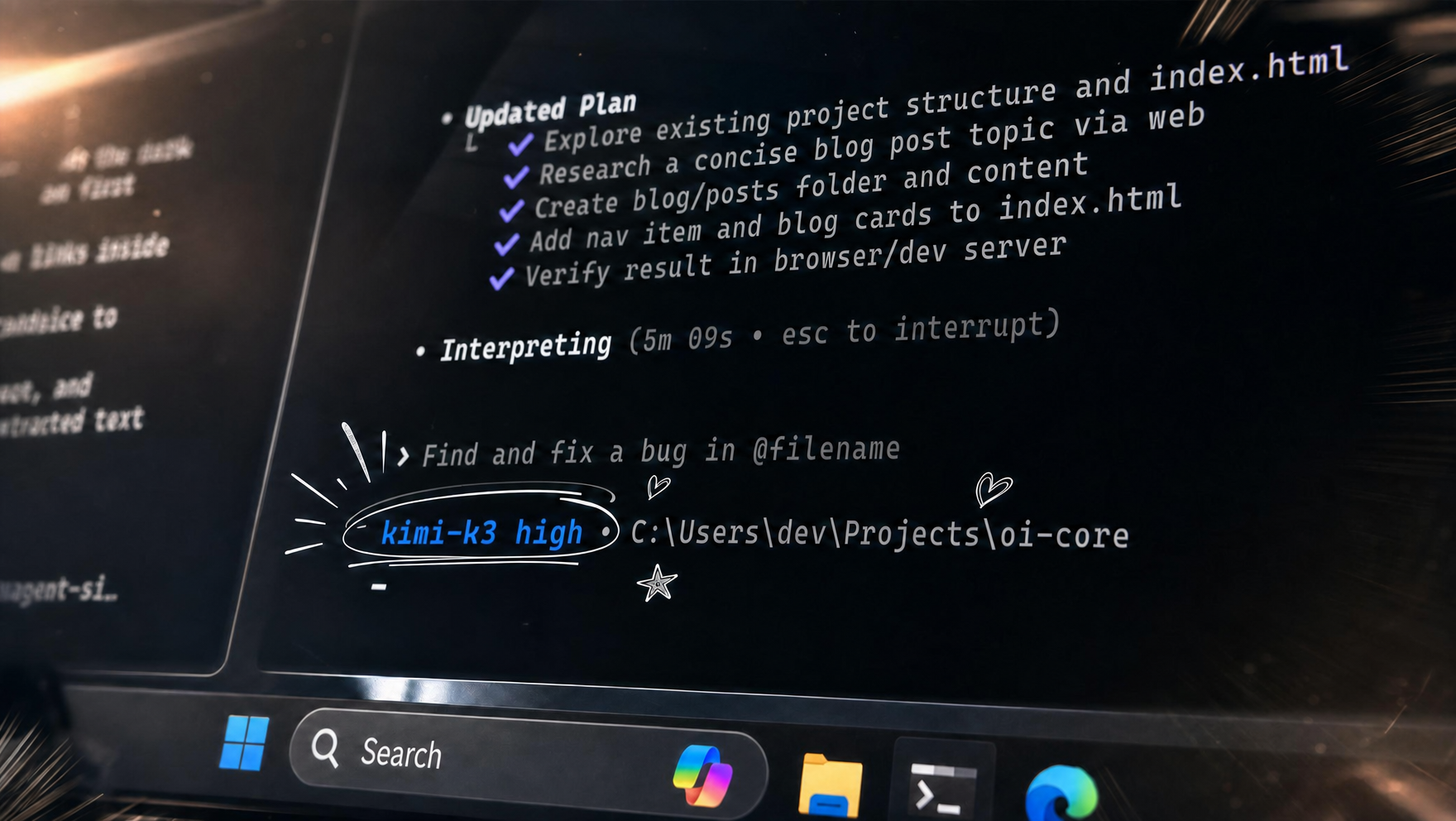
macOS and Linux:
curl -fsSL https://www.openinterpreter.com/install | shWindows:
irm https://www.openinterpreter.com/install.ps1 | iexThen type i or interpreter in your terminal to start a session.
Open Interpreter is a fork of OpenAI's Codex, with a focus on emulating the agent harness that gets the best performance out of low-cost models.
Use /harness to switch the active harness:
> /harness

native
claude-code
claude-code-bare
zcode
kimi-code
kimi-cli
qwen-code
deepseek-tui
swe-agent
minimal
Read more in the harness docs and provider setup guides.
Open Interpreter works in ACP-compatible editors and clients. Configure the client to launch interpreter acp; see the ACP guide for examples.
Already building with OpenAI's Codex SDK? Keep the SDK and make a one-line binary override:
-const codex = new Codex();
+const codex = new Codex({ codexPathOverride: "interpreter" });
Open Interpreter speaks the same Codex exec protocol. See the SDK guide and run scripts/test-codex-sdk-compat.sh for a local, provider-free compatibility check.
Open Interpreter should fit into your existing agent setup instead of trapping it in an Open Interpreter-only format. The product goal is to prefer shared, tool-neutral standards and directories, keep user-authored data in readable files, and make moving to or from another compatible agent straightforward.
Today that includes repository AGENTS.md, shared .agents/skills directories,
MCP, ACP, and the Codex exec protocol. Product-specific storage under
~/.openinterpreter is reserved for configuration and runtime state that does
not yet have a practical shared standard. Legacy product-specific skill
directories remain readable for compatibility, but new skills belong in
.agents/skills or ~/.agents/skills.
See the portability guide for the current boundary and the rules for evolving it.
Open Interpreter ships with a QA skill that lets any model operate and test interfaces. It can drive web apps in a real browser with agent-browser, or operate and test native apps with trycua.
- Runs commands inside native sandboxing on macOS, Linux, and Windows.
- Switches providers and models from the TUI with
/model. - Inspects or switches Rust-native model harnesses with
/harness. - Tests web and native apps through the built-in QA skill.
- Runs as an Agent Client Protocol agent for editors with
interpreter acp. - Reuses shared
AGENTS.mdinstructions and.agents/skillsdirectories. - Keeps product-only config and session state local under
~/.openinterpreter. - Supports
exec, MCP, skills, hooks, permissions, andAGENTS.md.
- Terminal docs
- Quickstart
- Install guide
- Configuration
- CLI reference
- Harnesses
- Model provider guides
- Agent Client Protocol
- Codex SDK
- Portability
- Sandbox & approvals
- Branding a distribution fork
Provider and model membership is generated, not maintained as Rust lists. From
codex-rs, refresh all hosted providers with
python3 scripts/write_provider_catalog.py, or repeat
--provider <provider-id> to update only selected provider entries. Live model
sources require the provider credentials documented in the
provider docs.
Note
This is the new Rust version of Open Interpreter, based on Codex. Looking for the original Python project? It lives on as a community-maintained fork at endolith/open-interpreter.
Apache-2.0




Languages
Share of the codebase by language, based on repository metadata from the host.
- Rust 96.3%
- Python 2.8%
- Starlark 0.2%
- TypeScript 0.2%
- Shell 0.2%
- PowerShell 0.1%
- JavaScript 0.1%
- HTML 0.1%
- CSS 0.0%
- Jupyter Notebook 0.0%
- Just 0.0%
- Smarty 0.0%
- MDX 0.0%
- Nix 0.0%
- Dockerfile 0.0%
- C 0.0%
Repository Radar analysis
Deterministic insights derived from public metadata and our observations — not personal testing or reviews.
Why this repository is interesting
- High absolute popularity (68,229 stars) signals broad adoption.
Who should use it
- Developers working primarily with Rust
- Teams exploring AI tooling, agents, or ML infrastructure
Potential use cases
- Reference or evaluate Rust open-source approaches in this domain
- Prototype AI/agent workflows or study reference architectures
Strengths
- README present in our index
- Declared license: Apache License 2.0
- Substantial fork count (5,872) suggests reuse and contribution interest
Limitations / considerations
- Insights are derived from public metadata and our observations — not a substitute for code review
What to watch
- Re-check last push, issues, and releases on GitHub before production adoption
Strong signals: Strong community interest
Source: GitHub (public metadata) + Repository Radar analysis. We do not claim ownership of third-party repositories.